Black spot
21/12/2025
A number of horticultural crops are challenged by black spot, which is also referred to by a number of names. It affects grapes where it is also known as anthracnose. Black spot affects apples and pears and is also known as apple scab and pear scab. In mangoes, black spot is caused by a bacteria rather than a fungus and is referred to as bacterial black spot. In broadacre, field peas are also affected by black spot.
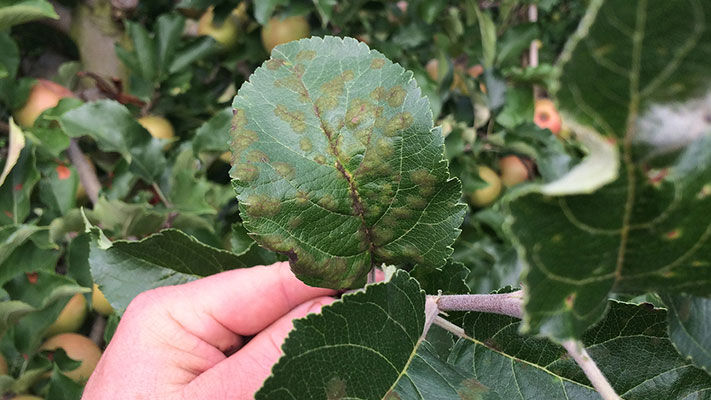
Description
With the exception of mangoes, black spot survives as sclerotia from the previous season’s infection and most commonly infects younger leaves and stems. Its development is most common in spring after rain which allows the fungal spores to spread and cause surface infection. In all instances, brown to black lesions result which can affect yield and fruit quality.
Control
Black spot is best managed by implementing a number of preventative measures to reduce the impact of the initial infection rather than trying to control the disease curatively. For each crop preventative measures differ, but will include;
- Planting of disease-free seed
- Rotate crops
- Prune trees or vines to remove disease and improve air flow
- Practice good orchard hygiene i.e. sterilise pruning tools, remove diseased fruit
- Remove infected leaf litter and plant material
- Apply preventative sprays.
Fungicides should all be applied before disease symptoms appear. Luna® Sensation and Flint® are registered for black spot control in apples and pears, Blue Shield® in apples, pears, mangoes and citrus. Blue Shield is recommended for the control of target spot (early blight) in potatoes and tomatoes. Antracol® is registered for black spot control in citrus and target spot (early blight) in potatoes and tomatoes. Aviator® Xpro® is registered for the control of black spot complex in field peas.
References
Doepel, R (1960), ‘Black spot of tomatoes, Journal of the Department of Agriculture, Western Australia, Series 4: Vol. 1 : No. 5 , Article 4,
https://researchlibrary.agric.wa.gov.au/cgi/viewcontent.cgi?referer=https://www.google.com/&httpsredir=1&article=1716&context=journal_agriculture4
Pestnet (Viewed October 2019), ‘Pacific Pests and Pathogens - Fact Sheets: Mango bacterial black spot (213)’, https://www.pestnet.org/fact_sheets/mango_bacterial_black_spot_213.htm
Pitkethley, R (2006), ‘Agnote: Bacterial Black Spot of Mangoes’, Department of Primary Industry, Fisheries and Mines, https://dpir.nt.gov.au/__data/assets/pdf_file/0016/233611/605.pdf
Taylor, A and Gordon, C (2019), ‘Black spot of grapevines in Western Australia’, Department of Primary Industries and Regional Development (DPIRD).