Codling moth
21/12/2025
Codling moth is the most damaging pest of apple, pear, quince and nashi crops in Australia, being endemic to all Australian States and Territories except Western Australia and the Northern Territory. Codling moths also affect walnuts and Japanese plums.
The larvae are internal feeders of the fruit and can decimate crops if not controlled, with one per cent of fruit with damage symptoms being the generally accepted threshold. Varieties that are harvested late in the season, such as Pink Lady are most at risk due to being exposed to the pest for longer periods.
Description
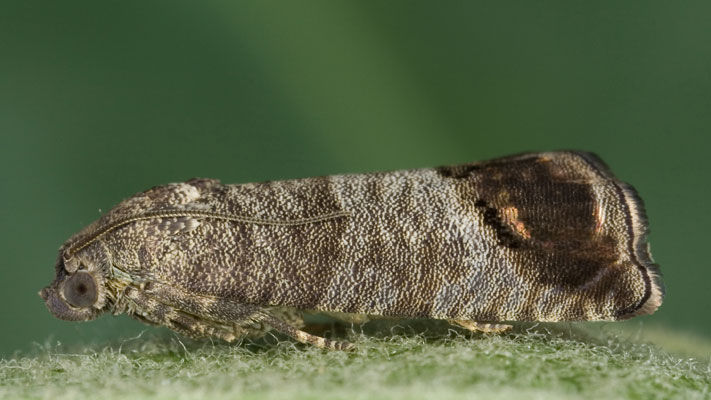
Adult moths are active at dusk in the warmer months, from spring through to autumn. They have mottled grey wings with a dark, iridescent coppery-brown band at the tip with a wingspan of up to 20 mm.
Codling moth larvae look very similar to worms with a dark brown head with a light pink body growing up to 20 mm long when mature.
Larvae penetrate the fruit and create tunnels leaving behind a reddish-brown frass (excreta) as they head toward the seeds. Once mature, the larvae tunnel back to the edge of the fruit. The internal damage created by the burrowing and subsequent breakdown by bacteria often leads to the fruit ripening prematurely and dropping early.
Control
Moth numbers are best monitored by traps. Burlap bands placed around tree trunks can help identify when larvae are about to pupate.
In addition to chemical control methods, there are a number of biological control methods that are being used by industry as a broader IPM strategy. These include; pheromone mediated mating disruption, codling moth granulosis virus and parasitic wasps.
References
Department of Primary Industries and Regional Development (2016), ‘Codling moth: declared pest’.
Herbiguide (2014), ‘Codling moth’, http://www.herbiguide.com.au/Descriptions/hg_Codling_Moth.htm