Fumitory
21/12/2025
There are 7 different species of this annual, herbaceous weed in Australia and while it can be difficult to correctly identify, it is crucial to be able to do so as herbicide susceptibility varies between species. In addition, resistance to some herbicide modes of action is growing in some fumitory populations. Fumitory is very competitive against pulses in particular, and due to its similar seed size can be very difficult to grade out of canola.
Description
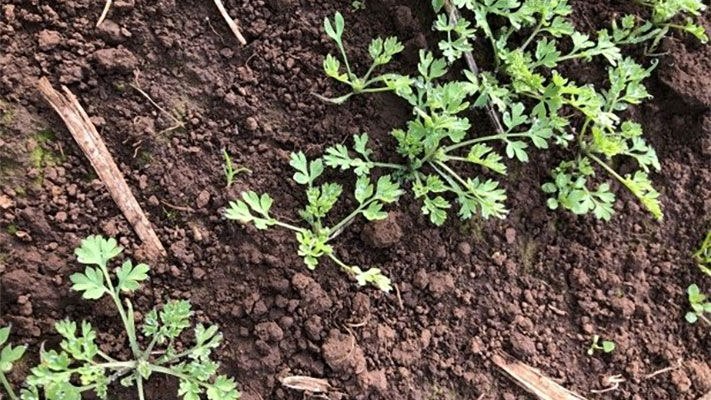
The cotyledons of fumitory are spear-shaped with a pointed apex and are hairless. Once the plant matures, fumitory is semi-erect to sprawling, with a climbing habit, slender, herbaceous, freely branching and between 30-70 cm tall. The leaves are triangular and deeply lobed, soft, hairless, green or blue-green in colour and arranged alternatively. The flowers occur in clusters of 10-40 flowers, 6-12 mm long and are white, pink or red depending on the species. To differentiate between species, consider the flower colour, width and length of leaves.
Control
There is significant variation within 5 of the 7 species in Australia, which may account for why some species are found in a range of environments and why fumitory control can be unpredictable and variable.
Velocity® is registered for control at the 2-6 leaf stage for Fumaria densiflora (Denseflower fumitory) and from the 2-leaf stage in wheat, cereal rye, triticale and barley. Sencor® is registered for post-emergent control of fumitory in barley, wheat, chickpeas, faba beans, lentils, vetch, white lupins, peas, potatoes and tomatoes. Hussar® is registered for the control of denseflower (Fumaria densiflora) and wall fumitory (Fumaria muralis) in wheat. Betanal® Flow is registered for common fumitory (Fumaria officinalis) control in beetroot, fodder beet and silverbeet. Tramat® is registered for the control of fumitory in beet crops, oil seed poppy crops and onions. Roundup Ready® with Plantshield® and Roundup Ready PL are both registered for the post-emergent control of fumitory.
For more information on the control of other fumitory species, check with your local Bayer representative.
References
Birchip Cropping Group (2014) ‘2014 BCG Season Research Results: Fumitory Control’, GRDC, https://www.farmtrials.com.au/trial/17657
Herbiguide (Viewed October 2019), ‘Common fumitory’, http://www.herbiguide.com.au/Descriptions/hg_Common_Fumitory.htm
Herbiguide (Viewed October 2019), ‘Denseflower fumitory’, http://www.herbiguide.com.au/Descriptions/hg_Denseflower_Fumitory.htm
Herbiguide (Viewed October 2019), ‘Wall fumitory’, http://www.herbiguide.com.au/Descriptions/hg_Wall_Fumitory.htm
Murrumbidgee Catchment Management Authority (2008), ‘Best Management Practices for Dryland Cropping Systems: Fumitory (Fumaria spp.)’, https://archive.lls.nsw.gov.au/__data/assets/pdf_file/0007/495349/archive-fumitory.pdf