Trials identify best cereal herbicide timing for maximum ryegrass control
21/05/2026
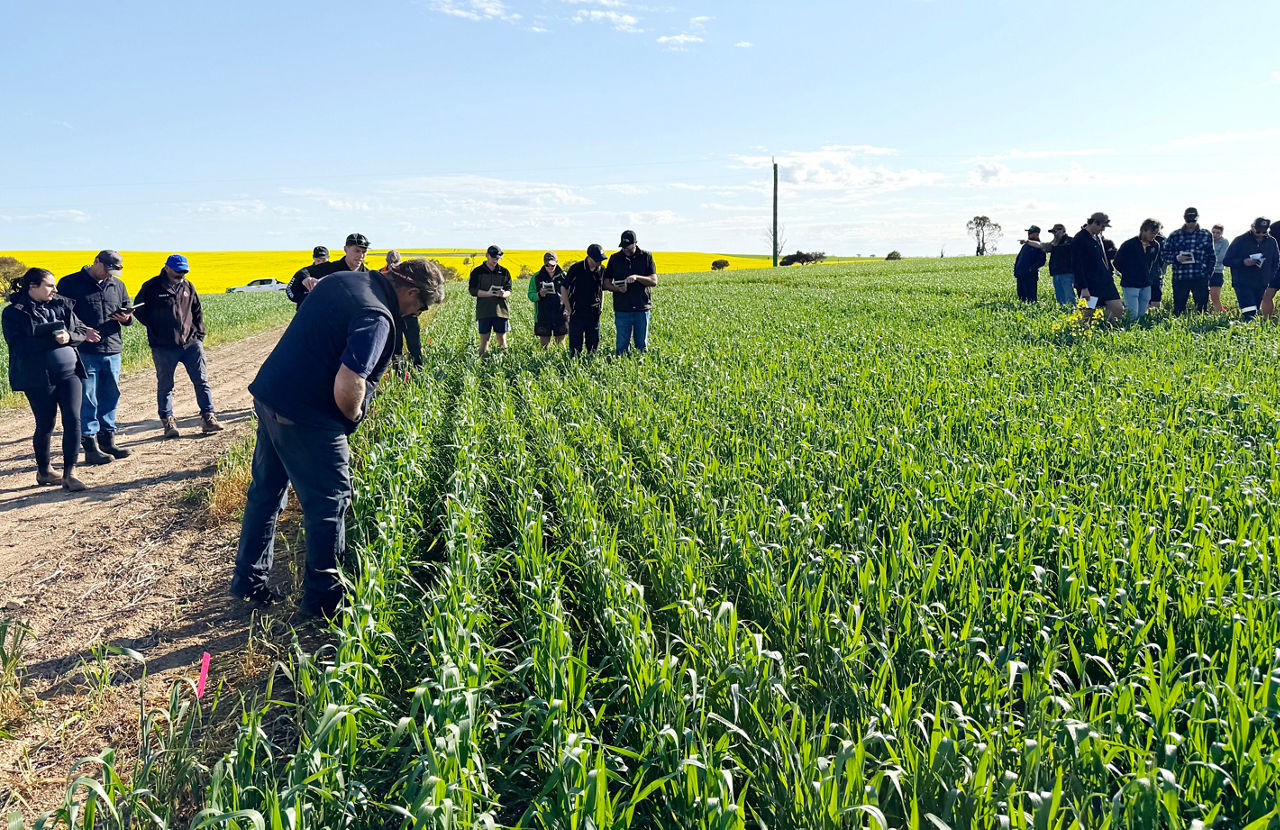
Ongoing “showpiece” trials assessing the best upfront herbicide strategies from crop protection companies against annual ryegrass continue to reinforce the use of industry-standard herbicides at the early post-emergence (EPE) application timing.
A leading farm consultancy group monitoring the trials has noted that, with land renovation accelerating across the country to achieve improved production, and its associated changes to farming systems, growers should also have a greater focus on the EPE timing to avoid increased crop phytotoxicity.
Conducted by specialist Western Australian private research and extension group, SLR, the showpiece trials continued last year for a fourth season at sites near Moora in the Midlands region, Cunderdin in the central wheatbelt and Narrogin in the Great Southern.
Undertaken in wheat, the trials compared leading pre-emergent and EPE herbicide strategies against annual ryegrass, as well as against volunteer canola at the Moora and Narrogin sites.
Evaluated in a similar way to GRDC National Variety Trials™, the trials compared a wide range of popular standard herbicides, including trifluralin, pyroxasulfone, Terrain® Flow, Valor®, Boxer Gold®, Overwatch®, Mateno® Complete, Luximax® and Voraxor® applied in a variety of combinations pre-emergent and early post-emergent.
Near Moora, the EPE application of Mateno Complete following pre-emergent treatments of trifluralin, Terrain Flow, Boxer Gold or Overwatch achieved 97-100% reduction in annual ryegrass panicles. This result was compared with standard pre-emergent only application of trifluralin and pyroxasulfone at 82%, Luximax and Voraxor at 43% and Overwatch and trifluralin at 67%, as well as the EPE application of prosulfocarb following pre-emergent application of Overwatch at 79%.
At Narrogin, the same EPE Mateno Complete applications following pre-emergent treatments achieved 96-100% reduction of annual ryegrass panicles compared with 79%, 72%, 77% and 97% for the other applications respectively.
At Cunderdin, EPE Mateno Complete following pre-emergent treatments delivered 74-91% reduction versus 69%, 56%, 59% and 72% for the other treatments respectively.
The EPE Mateno Complete applications also achieved a high level of control against volunteer canola: 98-100% at Moora and 94-98% at Narrogin. This compared with the prosulfocarb EPE application following pre-emergent treatment of Overwatch achieving 16% control of the volunteer canola at Moora and 92% control at Narrogin.
Mateno Complete contains aclonifen, pyroxasulfone and diflufenican, and the combination of these three active ingredients applied across the entire soil surface showed its strength in delivering about a 20% increase in annual ryegrass control compared with the application of pre-emergent herbicides alone. It also achieved higher control of annual ryegrass and volunteer canola when compared to the EPE application of prosulfocarb following pre-emergent use of Overwatch.
Synergy Consulting Principal Consultant David Pfeiffer said the SLR showpiece trials had demonstrated that EPE herbicide application was a “no-brainer” to help achieve maximum control of annual ryegrass.
“They highlighted that you get the best result with EPE application following an effective pre-emergent annual ryegrass herbicide, where the treatment across the whole surface controls ryegrass in the row and in the inter-row. And there’s no question that the leading product is Mateno Complete, with prosulfocarb a few per cent behind in its control,” David said.
“Mateno Complete controls a broader weed spectrum, including broadleaf weeds as well.”
He said Mateno Complete applications were only limited by growers’ own operational logistics and weather events, which was why the consultancy recommended they use it over about 25% of their cereal programs.
However, David said the large amount of land renovation works being undertaken by farmers was effectively changing farm systems and this could increase the emphasis on EPE applications in future.
“We are altering soil structures and this changes how we should use pre-emergent herbicides.”
“Department research in this area has shown biomass and crop emergence reductions, so it could be a case of cutting back pre-emergent applications and then topping-up at the EPE timing. We could pull pre-emergent application of trifluralin back to 1.5-2 litres per hectare and then use Mateno Complete EPE,” he said.