Eden Valley winegrape growers benefit from new early season fungicide strategy
About
-
Category
- Grower Stories
-
Date
05 August, 2022
-
Location
Eden Valley, South Australia
-

About
Category
- Grower Stories
Date
05 August, 2022
Location
Eden Valley, South Australia
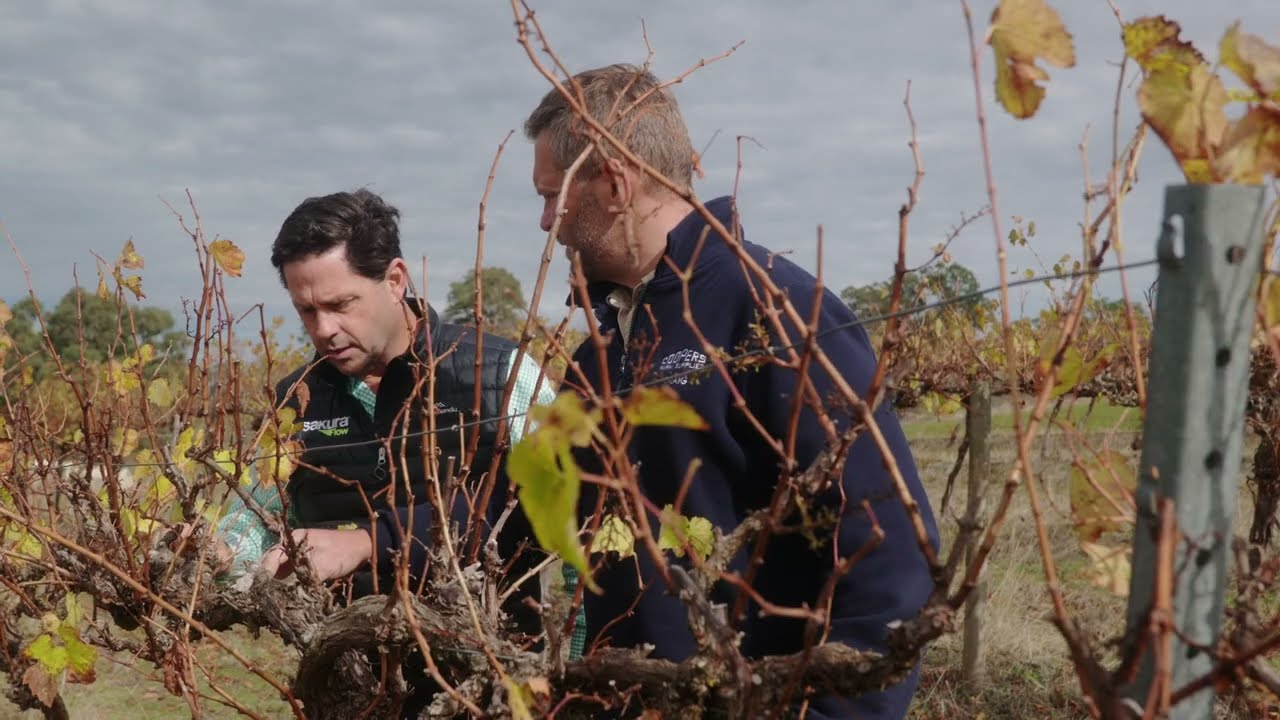

It has been the welcome outcome from adopting more rigorous early season fungicide programs, buoyed by the arrival of new options that are also reducing the threat of resistance or tolerance to existing fungicides.
The Eden Valley region produces about 6,000 tonnes of winegrapes annually, largely devoted to Riesling, Chardonnay, Shiraz and Cabernet Sauvignon varieties.
Craig John, agronomist with Coopers Farm Supplies at Mount Pleasant, said the area featured cooler and higher moisture conditions than the neighboring Barossa Valley, favouring increased incidence of grapevine diseases, particularly powdery mildew and botrytis bunch rot.
“Powdery mildew shows up most seasons and botrytis can be a problem too, especially when latent infections occur over flowering, followed by late rains and cooler, wet conditions at harvest,’’ Craig said.
He said strategic, robust fungicide spray programs starting from early in the season through to bunch closure was always encouraged, and they had been enhanced in recent times by the introduction of new, alternative fungicides like Luna® Experience.

Developed by Bayer, Luna Experience offers two fungicide modes of action (Groups 7 and 3), containing the active ingredients fluopyram, which belongs to the Succinate Dehydrogenase Inhibitor (SDHI) chemical class, and tebuconazole, which is a demethylation inhibitor (DMI) fungicide.
It extends on the company’s popular Luna Sensation fungicide, which is routinely applied for control of various diseases in almonds, fruit crops and lettuce.
“Foliar disease management has improved by commencing the spray programs very early in the season, soon after budburst, starting traditionally with sulphur and Prosper®, and then onto new SDHI and DMI fungicides leading up to the start of flowering, and in combination with strobilurins,’’ Craig said.
“Fungicides strategically applied over flowering through to bunch closure, such as Teldor®, Scala®, Switch®, Prolectus®, Flute®, Kusab® and Revus®, are often used in various combinations that provide the best outcome for disease management, also according to the grape variety susceptibility.
“We recently have introduced a more strategic, robust disease control program with different modes of action like in Luna (Experience).’’
To be at the forefront of early season disease management, up to four sprays from budburst to start of flowering are often encouraged, with tight spray intervals of 10-14 days.

“If you don’t keep tight spray intervals early, disease tends to get away later in the season, which, in some seasons with higher disease pressure, does make it a challenge for a saleable product. There are restrictions with wineries on the severity of disease on bunches at harvest time and growers can be penalised or rejected if these thresholds are exceeded. Harvest costs can also increase if having to hand pick selected bunches with lower disease severity.’’
He said with the combination of the Group 7 and 3 chemistry, Luna Experience provided excellent xylem mobility and persistence within the leaves and bunches of vines, resulting in very good control of botrytis and powdery spore production and germination activity.
“Luna Experience offers us the advantage over other fungicides of having the DMI in combination with the SDHI, as this provides stronger disease activity as well as long-term protection. It’s what we are looking for in a product for disease control.’’
“We have been able to use a robust product like Luna (Experience) to prevent botrytis latent infections at early flowering, as we can often get infections in this environment with the dewy nights or light rains. Luna (Experience) has noticeably reduced the disease closer to harvest, which helps lower the need and cost of using late season botryticides. So it’s added another tool to the program.’’
Craig said Amistar® Group 11 fungicide had traditionally been used as an option at this timing, however with Luna Experience offering a new mode of action chemistry, it could now be used in rotation with Amistar.
“In recent times for managing botrytis, we have used Amistar as our ‘go-to’ pre-flowering or early flowering fungicide. We are now aiming to rotate this Group 11 chemistry so we don’t build up disease resistance or tolerance to it.’’
“Previously, where overuse of Group 11 strobilurin fungicides for powdery mildew control has occurred, the disease has built up some level of resistance to it. Luna Experience provides a different mode of action chemistry to address that resistance.’’
He said Luna Experience had also been applied together with other fungicides at the pre-flowering stage, including for downy mildew, as well as with foliar nutrients, and had proven to have good tank mix compatibility with these other products.
About
Category
- Grower Stories
Date
05 August, 2022
Location
Eden Valley, South Australia
Related Products